
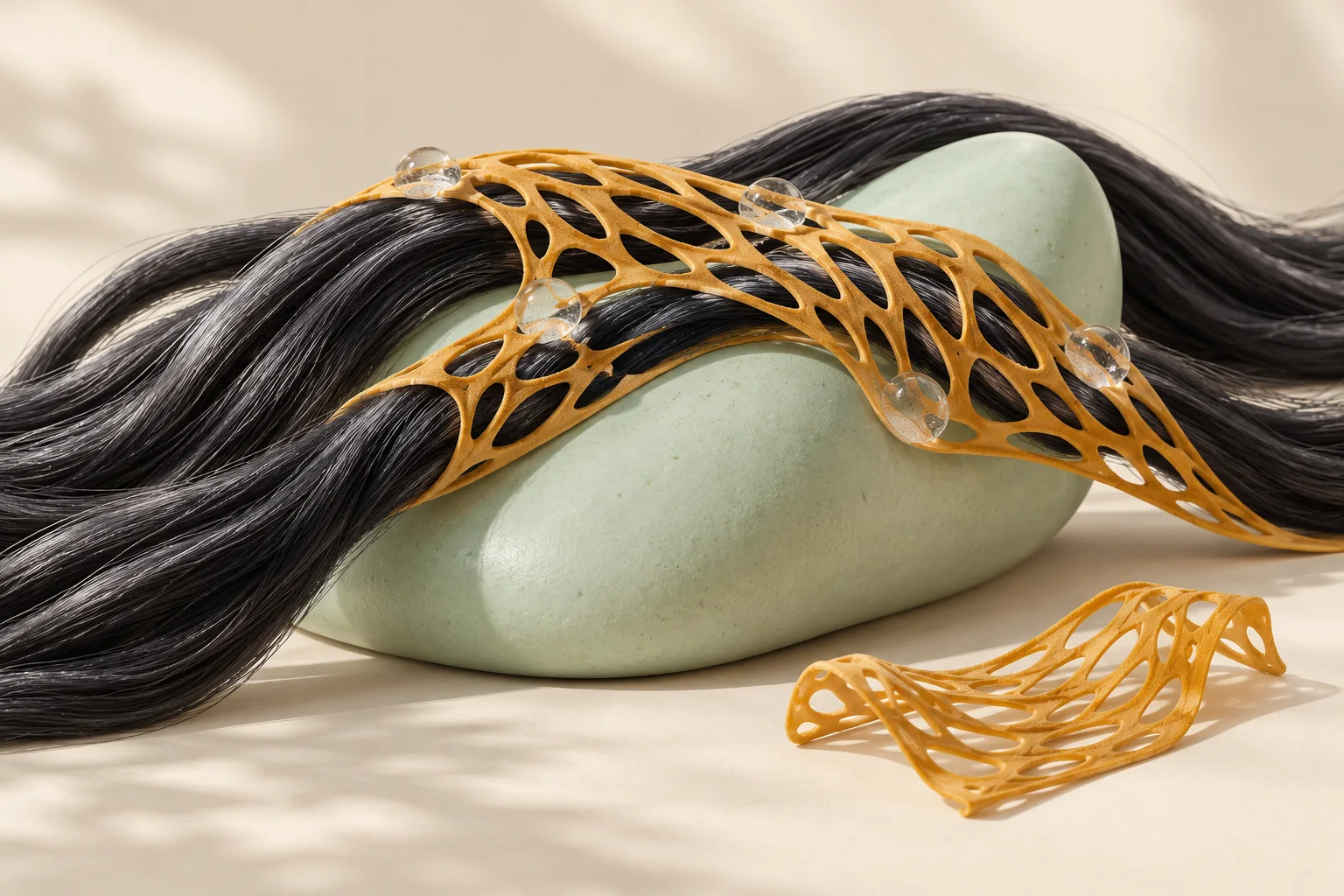
Published October 2, 2026, in Science Advances, this engineering study introduces MindStretcH, a source-named research prototype designed to maintain EEG contact through hair, movement and repeated use. It combines a kirigami-patterned elastomer mesh, deformable eutectic gallium-indium interconnects and detachable hydrogel conical electrodes.
What the materials are designed to do The open mesh adapts to differences in head shape while the liquid-metal connections tolerate deformation. Detachable hydrogel contacts are intended to combine scalp contact with reuse of the broader interface.
The reported research signal The abstract reports stable electrical performance under deformation, consistent task-related EEG during longitudinal motor-imagery recordings and repeated online brain-computer-interface experiments without measurable recording-quality deterioration. These are promising laboratory performance results, not evidence of a clinical benefit.
What remains unknown The checked abstract does not disclose participant number, demographics, recording duration, comfort findings, quantitative signal measures or a direct comparison with a conventional EEG system. Long-term home reliability, manufacturing reproducibility, clinical usefulness and regulatory status remain unestablished.
Source and disclosure Authoritative abstract checked. Competing-interest details were not available in the indexed abstract. Crossref lists multiple public, academic and philanthropic awards, including support from NSF, NIH, UT Austin and the Alzheimer's Association. Prepared with AI assistance and source-checked October 3, 2026.