
Source published October 11, 2026. Added to Neurofeedback.com October 12, 2026 after full-text review.
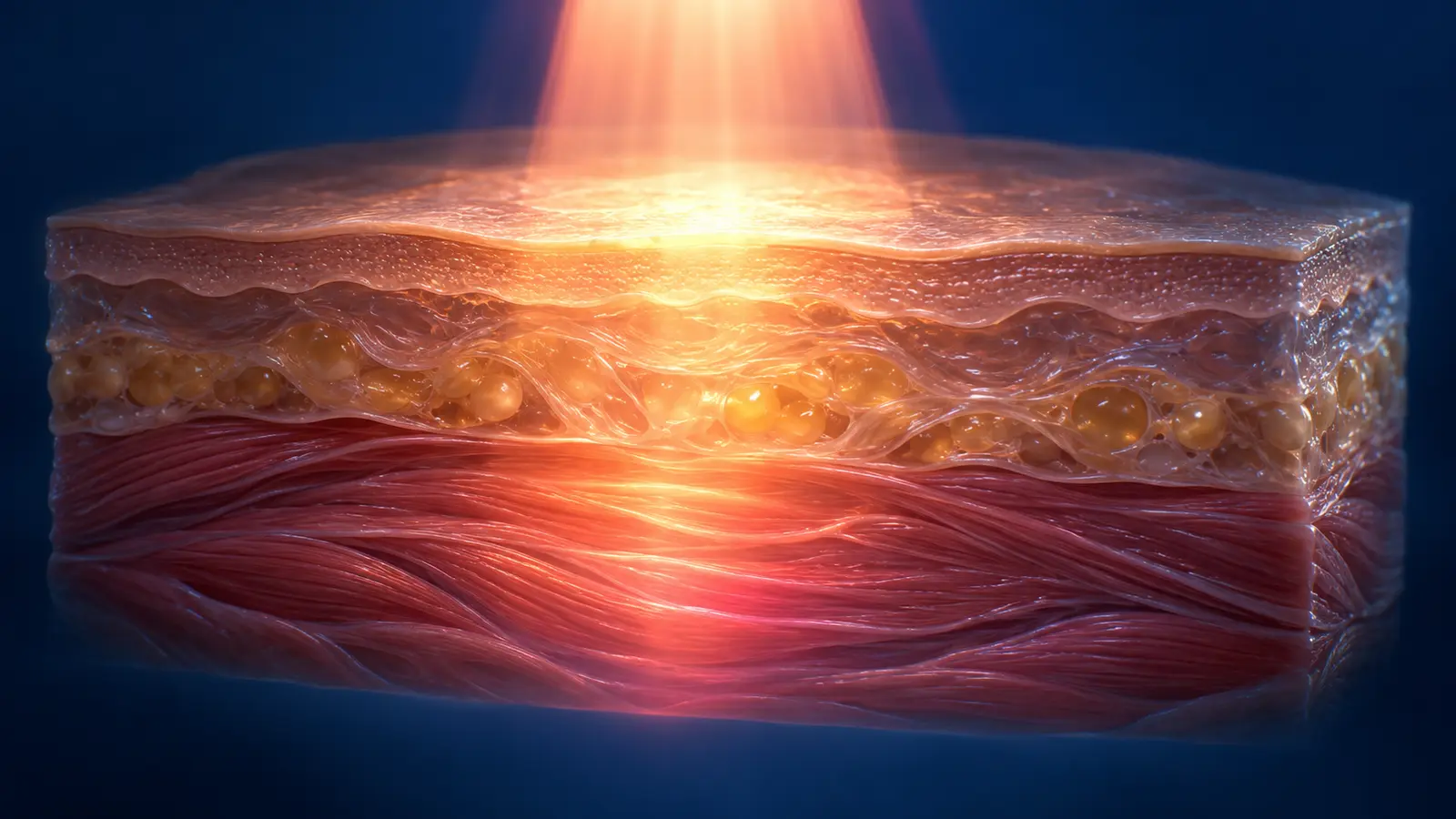
Researchers built a three-dimensional computational framework that combines light transport, tissue heating and a phenomenological model of ATP-related activity in layered skin, fat and skeletal muscle. They compared 810, 850 and 900 nm light while varying optical power and beam radius during a 180-second exposure.
At 850 nm with a 4 mm Gaussian beam radius, the modeled average ATP-related response in muscle reached a near-flat maximum of about 14.73% between 0.50 and 0.75 W, then declined to about 12.29% at 2.50 W. Maximum modeled temperature continued rising, from 38.584°C at 0.75 W to 45.857°C at 2.50 W.
The practical insight is that greater light delivery does not automatically mean a greater modeled cellular-energy response. PBM dose selection needs to balance penetration, biological response and thermal loading rather than treating power as a simple more-is-better control.
This is a computer model, not a human or animal treatment study. The ATP equation is phenomenological, tissue geometry and properties were assumed, and the diffusion approximation may underestimate near-surface heating. The authors call for experimental measurements and higher-fidelity light-transport modeling before physiological, clinical or safety interpretation. The numerical outputs are not clinical dose limits.
The authors declared no competing interests. The checked publisher page did not state a funding source.
AI-assisted source review and summary; no human clinical review is implied. The image is an AI-generated conceptual tissue model. It does not depict measured anatomy, a commercial device, tissue damage or a treatment result.