
Source published October 22, 2026: peer-reviewed prospective cohort study in Brain, with an institutional research announcement from Columbia University Irving Medical Center.
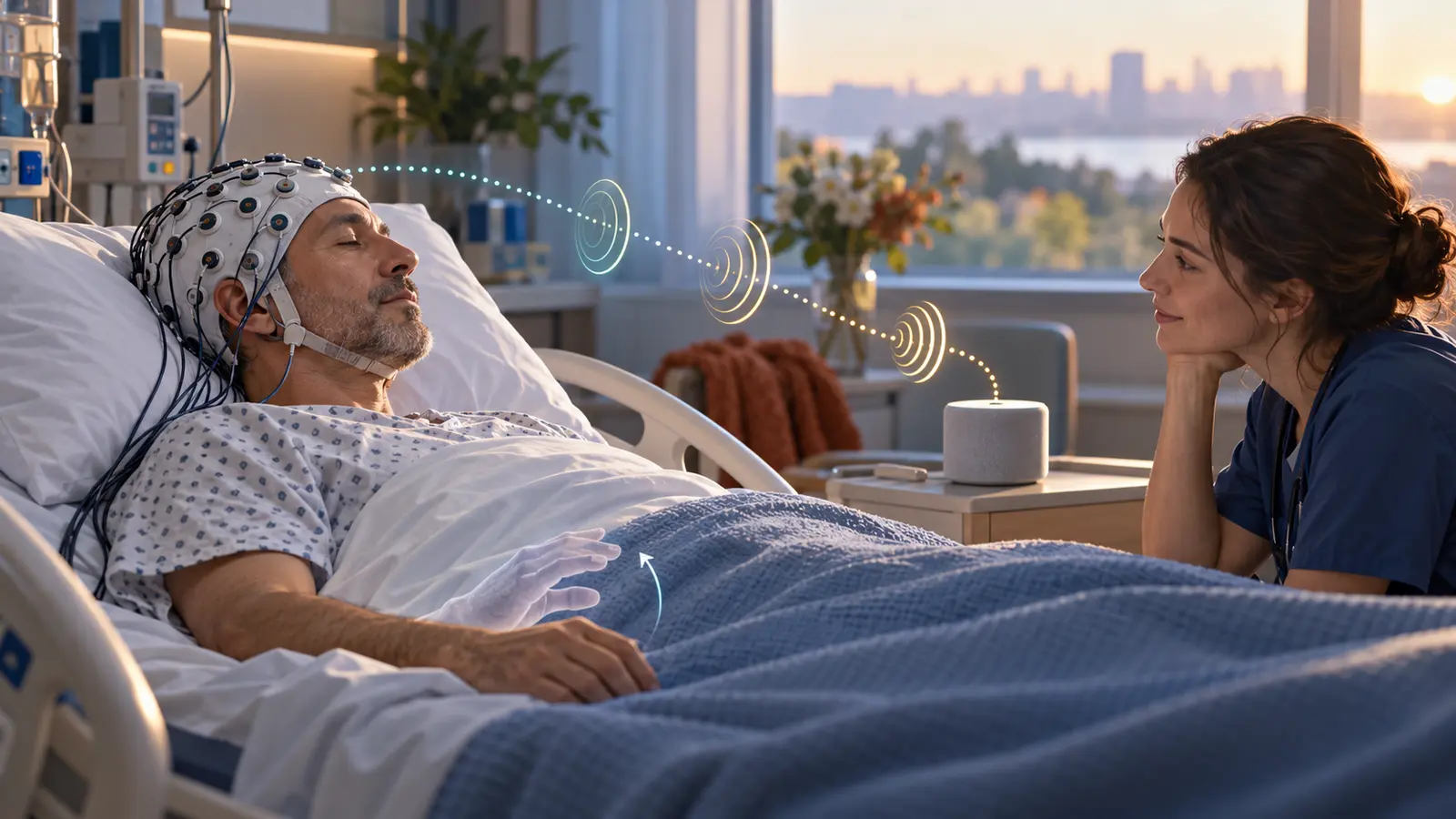
A signal of intentional control Researchers tested a bedside EEG-based brain-computer interface in 41 critically ill patients who were clinically unresponsive after acute brain injury. Patients were asked to attempt opening and closing the right hand to make a tone faster, then to stop the movement attempt to make it slower. Thirteen of 41 patients, or 32 percent, achieved control of this one-way interface. A separate EEG analysis identified cognitive motor dissociation in eight patients.
Why the result is encouraging The interface gives clinicians a way to look for intentional control even when a patient cannot produce a visible response. Four of 13 patients who controlled the interface recovered clinical consciousness by hospital discharge, compared with one of 28 who did not. At 12 months, six of 13 with control and two of 28 without control had recovered the study's threshold for functional independence.
The important boundaries This was a prospective single-center cohort, not a randomized treatment trial. The outcome estimates were imprecise, with very wide confidence intervals, and association does not prove that interface control caused recovery. The system changed a tone and did not yet allow patients to send open-ended messages. The study offers early evidence for detecting preserved agency and a path toward future two-way communication, not a clinical communication product or a prognosis by itself.
Funding and interests The institutional announcement reports support from the National Institutes of Health, Paris Brain Institute America, the Canadian Institutes of Health Research, Fondation CHUM and the Royal College of Physicians and Surgeons of Canada. It states that the authors reported no competing interests.
Why it matters A reliable bedside route from hidden intention to a simple external signal could help research teams develop more direct communication tools for patients whose motor output does not reflect their awareness. Replication across centers, faster feedback, validated decision thresholds and careful study of false positives and false negatives are essential before routine use.
Disclosure This is a research summary, not a diagnostic, prognostic or treatment recommendation. Prepared with AI assistance; PubMed, Crossref and the institutional source were checked October 24, 2026. The image is an AI-generated conceptual scene with fictional people. It is not a study photograph, specific device, EEG result or patient outcome.