
Source first published online August 18, 2026. Historical addition to Neurofeedback.com, added October 8, 2026.
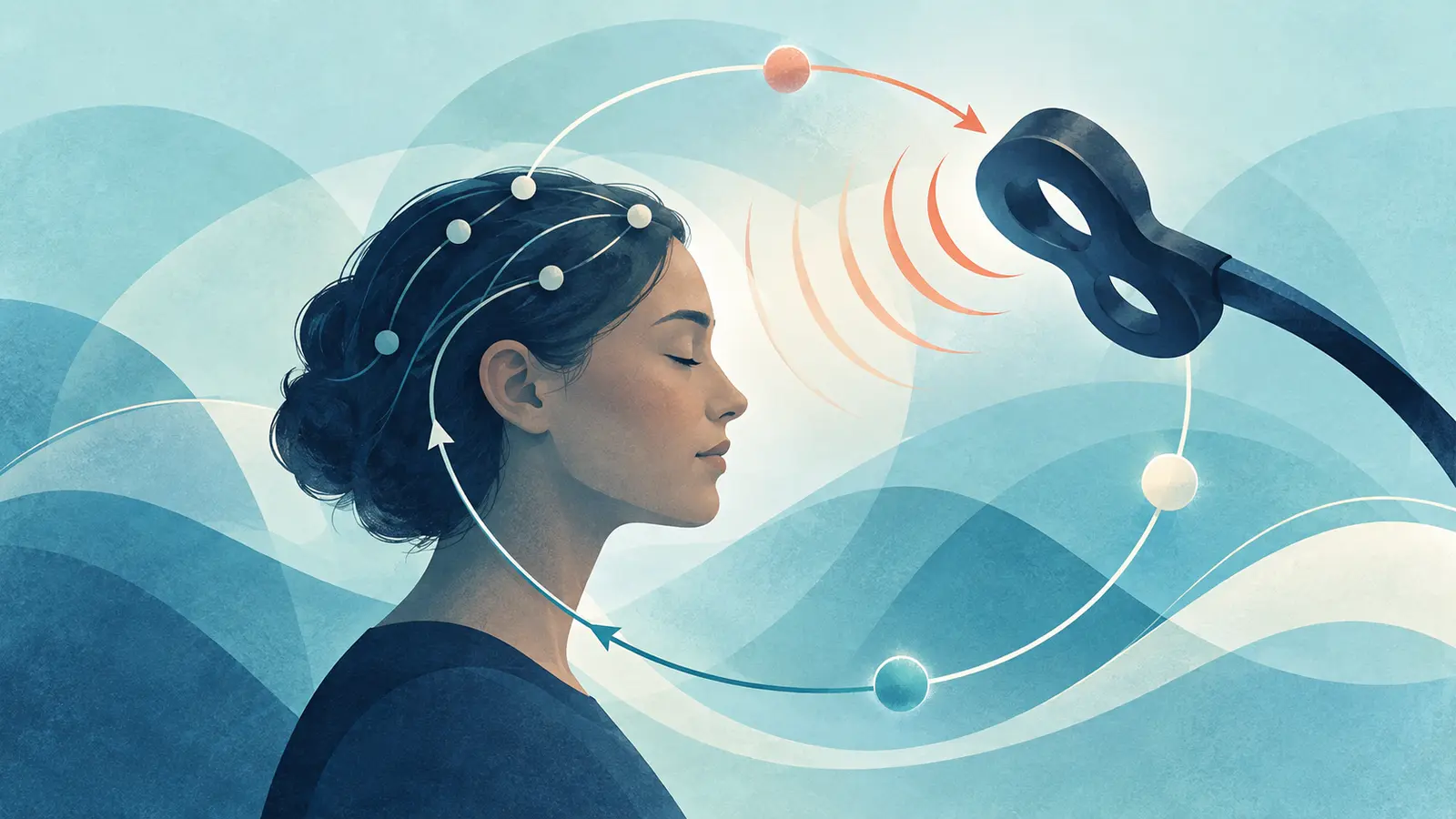
A study involving 25 participants tested a closed-loop system that combined EEG, TMS and reinforcement learning. The algorithm learned each person's mu-rhythm phases associated with relatively higher and lower corticospinal excitability instead of requiring researchers to select one phase in advance.
The system identified those participant-specific phases. Repeated stimulation at the two learned phases was followed by directionally different longer-term EEG coherence changes in the targeted sensorimotor network. This demonstrates a practical route for making experimental stimulation timing more responsive to individual brain state.
This was a physiology and feasibility experiment, not a clinical treatment trial. It did not measure symptoms, functional recovery or patient benefit. The checked abstract does not provide adverse-event results, exact effect estimates, attrition or independent replication, and EEG coherence should not be interpreted as a clinical outcome.
European Research Council grant 810377 is indexed. One author reported patents and patent applications related to TMS technology; the other authors reported no conflicts.
AI-assisted source review and summary; no human clinical review is implied. The image is an AI-generated conceptual illustration, not measured EEG data, actual equipment or a treatment result.